

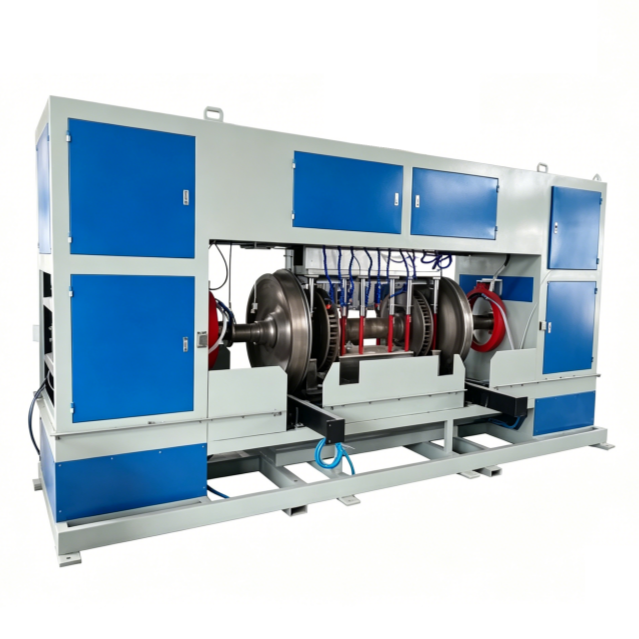
In modern rail transit, high loads and elevated speeds place punishing demands on running gear safety. As the absolute heart of a train’s rolling stock, the wheelset and axle constantly endure alternating stresses, heavy impacts, and severe mechanical friction. If a hairline crack develops on an axle surface, the relentless fatigue of daily operations can cause it to propagate rapidly, potentially leading to catastrophic axle failure.
How do maintenance teams catch these microscopic, invisible hazards without compromising the component’s integrity? The answer lies in Magnetic Particle Inspection (MPI)—the indispensable non-destructive testing (NDT) method that serves as the “eyes” of railway maintenance.
1. What is Railway Axle Magnetic Particle Inspection?
Magnetic Particle Inspection (commonly referred to as MT or MPI) is one of the five core techniques in Non-Destructive Testing (NDT). It is specifically engineered to detect surface and near-surface discontinuities—such as fatigue cracks, inclusions, and seams—in ferromagnetic materials.
The Physics Behind the Process
The core mechanism of MPI boils down to three distinct phases: Magnetization, Leakage, and Attraction.
- Magnetization: A specialized railway testing bench passes a heavy electrical current or magnetic flux through the axle, establishing a closed-loop magnetic field within the steel.
- Flux Leakage: If the axle surface is perfectly sound, the magnetic lines of force remain trapped inside the metal. However, if a crack interrupts the path, the magnetic field is forced to distort and leap out of the surface, creating a localized magnetic leakage field.
- Particle Attraction: When a wet medium containing finely divided ferromagnetic particles (magnetic ink) is applied to the axle, these particles are instantly drawn to the leakage field. They cluster tightly along the boundaries of the flaw, creating a highly visible, distinct magnetic particle indication.
2. Why Choose MPI for Axles and Wheelsets?
With alternative NDT methods available—such as ultrasonic testing (UT) or dye penetrant testing (PT)—why does magnetic particle inspection remain the industry standard for axle surface validation?
- Extreme Sensitivity to Surface Fatigue: Rail axle failures almost always originate from surface-breaking fatigue cracks. MPI offers unmatched sensitivity for capturing these micro-cracks, even when they are only microns deep.
- Direct, Visual Confirmation: Unlike ultrasonic waveforms that require complex screen interpretation, MPI produces physical “maps” of the defects directly on the component. This makes characterization fast and highly reliable.
- High-Volume Efficiency: Modern maintenance depots process massive fleets. Dedicated, semi-automated railway MPI machines can magnetize and spray an entire axle simultaneously, meeting the strict turnaround times of heavy maintenance workshops.
- Conquering Complex Geometries: Axles are rarely uniform; they feature complex transitions, including wheel seats, gear seats, dust guard seats, and delicate fillets (R-transitions). MPI adapts beautifully to these geometry shifts where other methods struggle with signal geometry noise.
3. Step-by-Step: The Railway Wheelset Inspection Routine
Executing a compliant railway axle inspection requires a rigid, controlled technical sequence:
Step 1: Pre-Cleaning and Surface Preparation
Oil, grease, scale, and protective coatings act as barriers that trap magnetic particles or mask flaws. Technicians utilize chemical degreasers or mechanical blasting to strip the axle down to bare, clean metal before running the test.
Step 2: Combined Magnetization and Suspension Spray
The wheelset is loaded onto a heavy-duty Railway Wheelset Magnetic Particle Testing Machine.
- Combined Magnetization: To optimize efficiency, systems utilize multi-directional magnetization. Passing current through the axle (circular magnetization) reveals longitudinal cracks, while an external coil (longitudinal magnetization) reveals transverse cracks. Doing both at once ensures total coverage in a single cycle.
- Fluorescent Wet Bath: Modern rail standard operations favor fluorescent magnetic particles suspended in a fluid carrier. Under an industrial UV-A (black light) lamp, the particles at a defect site glow a brilliant neon yellow-green. This high-contrast indication dramatically reduces inspector eye strain and prevents missed calls.
Step 3: Evaluation and Interpretation
Under strict darkroom conditions, certified NDT personnel review the axle, paying meticulous attention to high-stress concentration areas like the wheel-seat transitions. Indications are measured against international railway compliance standards (such as ASTM or local railway authority specs) to determine accept/reject criteria.
Step 4: Demagnetization and Post-Cleaning
Residual magnetism left in a rail axle can attract metallic debris during track operation, accelerating mechanical wear on bearings and gears. Therefore, a critical final step is passing the axle through a high-intensity demagnetizer to bring residual field levels back within safe limits.
4. The Future of Rail NDT: Automation and Intelligence
As the industry shifts toward smart rail infrastructure, traditional magnetic particle benches are evolving:
- Fully Automated Inline Systems: From initial washing stations to final demagnetization, modern lines utilize robotic handling to move heavy wheelsets smoothly through the NDT workflow, minimizing human error.
- AI-Powered Machine Vision: High-resolution camera matrices are now being integrated into darkrooms. Deep-learning algorithms scan the fluorescent indications, automatically flagging suspect cracks to assist the inspector, ensuring a dual-layer validation process.
- Complete Digital Traceability: Inspection logs, high-resolution UV imagery, and calibration data are automatically uploaded to asset management platforms, building a permanent, traceable digital birth-certificate for every single axle.
Conclusion
The magnetic particle inspection of railway wheelsets is a masterclass in preventative maintenance. By catching microscopic structural vulnerabilities before they ever leave the maintenance depot, MPI provides the technical certainty that keeps high-speed rail lines running safely across the globe.
Are you optimizing your rolling stock maintenance facility? Whether you require custom-engineered railway MPI benches, premium fluorescent materials, or expert NDT technical consultancy tailored to standard industry specifications, reach out to our engineering team today for a tailored solution.