

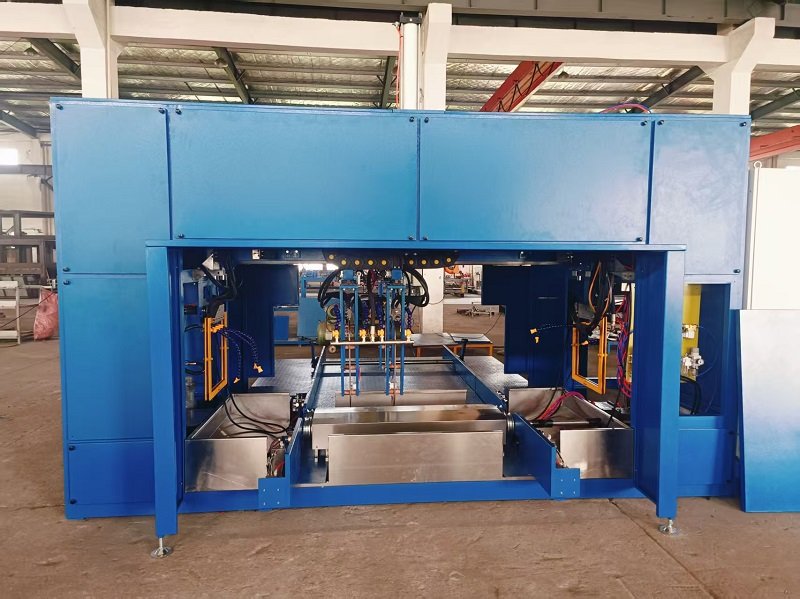
In the rail transit industry, the safety of train wheelsets directly impacts the lives of thousands of passengers and heavily influences fleet operational costs. As a railway depot manager, quality control engineer, or maintenance line supervisor, you might be facing these common challenges:
- Low manual inspection efficiency that fails to keep pace with tight rolling stock maintenance schedules.
- Risk of missed defects, where micro-cracks or subsurface fatigue damage slip through, creating massive liability risks.
- Overwhelming equipment options, leaving you unsure which configuration fully complies with strict international rail standards (such as EN, UIC, or ASTM).
Magnetic Particle Inspection (MPI/MT) is recognized globally as the most reliable and sensitive method for detecting surface and near-surface defects in train wheelsets. Choosing the right MPI equipment and process determines your overall overhaul quality and workshop efficiency.
Here is what you need to know to select the ideal wheelset inspection solution for your operations.
1. Why is MPI the Gold Standard for Train Wheelset Inspection?
During long-term operations, train wheelsets, axles, and rims endure immense alternating cyclic loads. This makes critical areas like the tread, wheel rim, web, and journal highly susceptible to fatigue cracking.
Compared to other Non-Destructive Testing (NDT) methods, Magnetic Particle Testing offers irreplaceable advantages:
- High Direct Visibility: Defect indications (magnetic particle accumulation) appear directly on the surface, making crack length and orientation instantly visible.
- Extreme Sensitivity: It easily detects microscopic surface cracks that are invisible to the naked eye.
- Industry Compliance: It perfectly aligns with the mandatory regulatory standards enforced by global railway bureaus.
2. 3 Must-Have Features of a High-Performance Wheelset MPI Machine
When planning a new NDT line or upgrading an existing workshop, look for a magnetic particle testing system that delivers on these three core capabilities:
A. Combined/Multi-Directional Magnetization to Eliminate Blind Spots
Top-tier wheelset MPI machines utilize combined magnetization technology (simultaneous circular and longitudinal magnetization). By controlling multi-channel currents, the system creates a three-dimensional vector magnetic field. This ensures that whether cracks are longitudinal or transverse, they are revealed clearly in a single magnetization cycle, drastically reducing cycle times per wheelset.
B. High Automation & Integrated Demagnetization
- Automated Handling: Wheelsets should automatically enter the inspection station via a heavy-duty conveyor or roll-in track, eliminating frequent crane lifting and preventing wheel surface scratches.
- Auto-Spraying & Rotation: The system should evenly apply fluorescent magnetic ink while automatically rotating the wheelset $360^\circ$ for seamless visual inspection.
- Decaying Demagnetization: Post-inspection, the system must feature an automated AC/DC decaying demagnetization cycle to ensure residual magnetism complies strictly with international standards (typically $\le 0.3\text{ mT}$ or $3\text{ Gauss}$).
C. Fluorescent Media paired with Smart AI Vision (Optional)
The mainstream industry choice is the Fluorescent Wet Method. Under high-intensity Overhead LED UV-A lamps inside an inspection booth, micro-cracks glow with a bright yellow-green hue. For Smart Rail Depots (Industry 4.0), advanced systems can now integrate AI-driven Vision Recognition. High-resolution industrial cameras capture defect indications automatically, reducing human error and archiving digital records for full traceability.
3. Customizing Solutions for Your Specific Rail Grid
We understand that High-Speed Rail (EMUs), Metros (Urban Transit), Locomotives, and Freight Cars all have vastly different wheelset dimensions, axle loads, and maintenance cycles:
- Metro/Subway Depots: Require high-throughput, compact footprints, and rapid pipeline operations.
- High-Speed Rail Depots: Demand extreme precision and flawless data traceability, requiring robust software to log defect data for every single serial number.
- Freight Car Repair Shops: Require rugged, heavy-duty build quality to handle harsh workshop environments and high pollution/dust tolerance.
Therefore, “one-size-fits-all” standard machinery rarely works. A tailored, custom-engineered NDT inspection line is always the most cost-effective and reliable choice.
4. Looking for a Trusted Rail Wheelset MPI Partner?
If you are designing a new workshop layout, preparing a tender, or upgrading your current non-destructive testing capabilities, we are here to help. We don’t just sell machinery—we deliver turnkey NDT solutions that pass stringent railway audits.
What We Offer:
- Complimentary Technical Consultation: Get custom layout drawings and technical specifications tailored to your workshop space, wheelset types, and daily throughput requirements.
- Global Standard Compliance: Our equipment fully adheres to international standards like EN 12927, ASTM E1444, ISO 9934, and railway-specific norms.
- End-to-End Support: From on-site installation and calibration to audit assistance and certified operator training, we ensure your line runs smoothly from day one.
💡 Need Technical Specifications or a Fast Quotation?
Click Contact us to speak with our NDT application engineers or email us directly at sales@newk-ndt.com
Simply drop us a quick message regarding your wheelset types and estimated daily volume, and our technical team will provide a customized proposal and product brochure within 24 hours!