

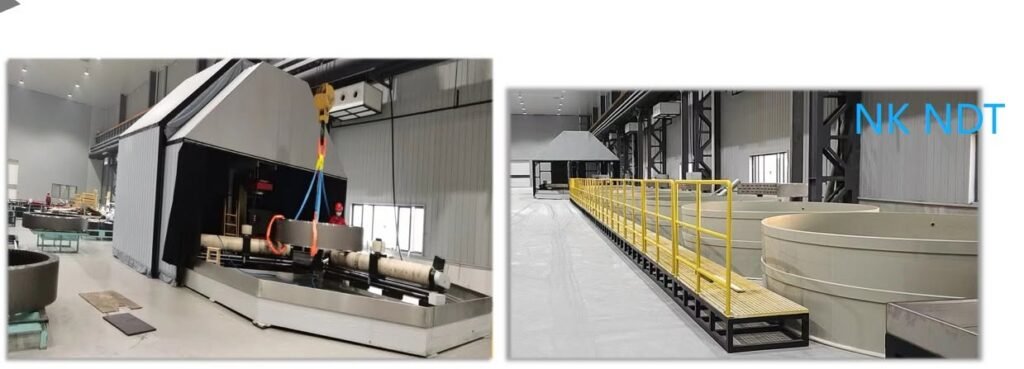
The wind energy sector is moving ruthlessly toward larger, higher-megawatt turbines. As a direct result, critical drive train components—specifically yaw and pitch ring gears, slewing bearings, and large forged rings—are scaling up in both diameter and weight. Operating under continuous rotational stress, severe cyclic mechanical loads, and harsh offshore/onshore environments, these massive components tolerate zero internal or surface defects.
For critical ferromagnetic components, Magnetic Particle Inspection (MPI) remains the industry-standard methodology for detecting surface and near-surface discontinuities like quenching cracks, laps, seams, and grinding defects. However,when a ring gear’s diameter scales past 3,000 mm or 5,000 mm, standard off-the-shelf MPI equipment becomes entirely obsolete.
The Engineering Challenges of Inspecting Mega-Diameter Ring Gears
Inspecting a heavy-duty wind power ring gear is a massive material handling and electromagnetic engineering challenge. Quality control managers routinely face four critical bottlenecks:
- Extreme Geometry & Footprint: Modern ring gears routinely exceed 3,000 mm to 5,000 mm in diameter. Standard horizontal wet MPI benches simply cannot accommodate these footprints.
- Tonnage and Handling Risk: A single forged ring gear can weigh several tons. Safely loading, clamping, and rotating these workpieces without damaging the machined teeth requires heavy-duty, integrated mechanical handling systems.
- 360° Multi-Directional Surface Coverage: Defects can orient in any direction across the inner diameter (ID), outer diameter (OD), and complex gear tooth profiles (root and flank). Ensuring 100% fluorescent particle coverage without missing blind spots is highly labor-intensive.
- Magnetic Field Attenuation: Achieving the mandatory magnetic field strength (typically at least 30 Gauss / 2.4 kA/m per international standards like ISO 9934 or ASTM E1444) uniformly across a massive surface area is incredibly difficult. Standard magnetization methods often lead to field dead zones, causing critical flaws to go undetected.
Non-Standard Customization: Engineered MPI Solutions for Wind Power
To overcome these limits, standard inspection benches must give way to highly customized, non-standard MPI systems tailored to the exact dimensions of your wind components. Optimized heavy-duty MPI lines integrate several advanced engineering features:
1. Multi-Vector Heavy Current Magnetization
Instead of relying on single-direction coils, custom systems utilize multi-directional, heavy-current power supplies (often multi-thousand Ampere systems) combined with specialized contact pads and auxiliary conductors. This allows for localized or multi-directional magnetization, ensuring both longitudinal and circumferential defects are captured in a single cycle.
2. Specialized Multi-Axis Rotating Stations
To handle multi-ton loads, systems are engineered with heavy-duty motorized rollers or turntables. This allows the ring gear to rotate smoothly at controlled speeds under fluorescent UV-A lamps, giving inspectors safe, effortless, and comprehensive visual access to the tooth roots and flanks.
3. High-Output Fluorescent Spray and Lighting Arrays
Customized lines feature automated or semi-automated wet particle application systems that flood the massive workpiece uniformly. Coupled with overhead, high-intensity LED UV-A lamps, indication contrast is maximized even in deep gear geometry.
4. Advanced Integrated Distributed Demagnetization
Large rings are notorious for holding high levels of residual magnetism, which can interfere with turbine operation or attract metallic debris in the gearbox. Custom solutions incorporate integrated, low-frequency, or distributed multi-coil demagnetization systems that scale down the residual field to strictly acceptable industry thresholds (e.g., < 2 Gauss).
The Shift Toward Automated NDT Systems
While manual inspection leaves too much room for operator fatigue and inconsistent record-keeping, semi-automated or fully automated MPI lines are shifting the paradigm for wind component manufacturers:
- Unmatched Consistency: Automated clamping, spraying, and magnetization cycles eliminate human error, ensuring every ring gear is tested under identical, verified parameters.
- Enhanced Throughput: Optimized material handling lowers cycle times significantly, allowing quality control to keep pace with high-volume forging and machining lines.
- Digital Traceability: Modern systems log critical inspection data (current levels, shot times, bath concentrations) for rigorous compliance auditing.
Partner with a Dedicated Non-Standard NDT Expert
At our core, we believe that massive, high-value wind power components demand more than just a catalog product. Our engineering team specializes in the non-standard customization of large-scale Magnetic Particle Inspection (MPI) systems and Fluorescent Penetrant Inspection (FPI) lines. We design around your specific facility footprint, tonnage limits, and throughput targets to deliver a rugged, high-precision NDT solution.
Whether you are manufacturing yaw rings, wind turbine bearings, or large industrial forgings, contact our engineering team today to co-develop a technical proposal tailored to your operation.