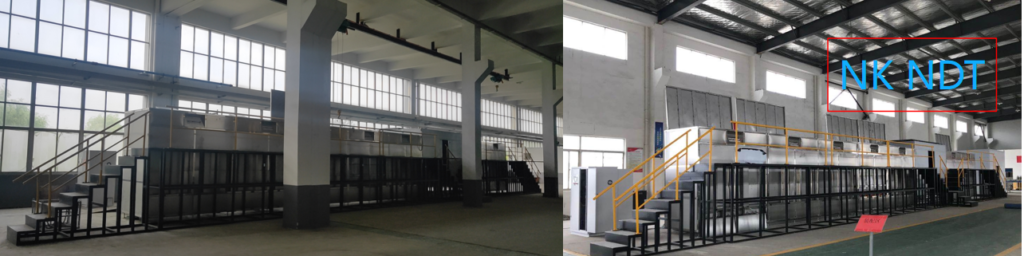
Learn how fluorescent penetrant inspection lines improve defect detection for aerospace and precision components with high accuracy and automated processes.
Aerospace manufacturing requires extremely strict quality control because even small surface defects can affect component safety and performance.
For non-ferromagnetic materials such as aluminum, titanium, and nickel alloys, magnetic particle inspection cannot be applied. Instead, manufacturers often use fluorescent penetrant inspection (FPI) technology.
A modern fluorescent penetrant inspection line provides an efficient and reliable solution for detecting surface cracks, pores, and discontinuities in aerospace components.
What Is Fluorescent Penetrant Inspection (FPI)?
Fluorescent penetrant inspection is a non-destructive testing method that uses fluorescent dye penetrant to reveal surface-breaking defects.
The basic process includes:
- Cleaning
- Penetrant application
- Penetrant dwell time
- Washing
- Developer application
- UV light inspection
- Final evaluation
Under ultraviolet (UV-A) light, defects appear as bright fluorescent indications, allowing inspectors to identify even very small cracks.
Why Aerospace Industries Use FPI
Aircraft components operate under extreme conditions including:
- High temperature
- Mechanical stress
- Vibration
- Repeated loading cycles
Small surface defects may develop into serious failures.
FPI provides high sensitivity for detecting:
- Surface cracks
- Fatigue cracks
- Porosity
- Leakage defects
Main Advantages of Automated FPI Lines
1. Stable Inspection Quality
Manual processes may cause variations in:
- Penetrant application
- Cleaning quality
- Inspection conditions
An automated FPI line controls process parameters precisely, ensuring consistent results.
2. Suitable for Mass Production
Aerospace suppliers often manufacture large quantities of precision parts.
Automated FPI systems can include:
- Automatic transportation
- Programmable process control
- Multiple treatment stations
- UV inspection areas
This improves production efficiency.
3. Compliance With International Standards
Professional FPI systems are designed according to international NDT requirements, including:
- ASTM E1417/E1417M
- ISO 3452
- AMS 2644
They help manufacturers achieve consistent inspection procedures.
Typical Aerospace Applications
Fluorescent penetrant inspection is widely used for:
- Aircraft engine parts
- Turbine blades
- Aluminum structures
- Precision forgings
- Landing gear components
How to Select the Right FPI System?
Before selecting equipment, manufacturers should consider:
Part Size and Weight
Different components require different tank sizes, handling methods, and layouts.
Production Capacity
The system should match production requirements, including:
- Daily output
- Cycle time
- Automation level
Inspection Standards
Different industries may require specific procedures and certifications.
Factory Layout
Customized FPI lines can be designed according to available production space.
The Future of FPI Technology
With increasing demand for aerospace safety and manufacturing efficiency, automated fluorescent penetrant inspection systems are becoming more important.
Combining automation, digital monitoring, and intelligent inspection technology, modern FPI lines provide manufacturers with higher reliability and better quality control.