

Introduction
With the increasing demand for high-quality manufacturing, traditional manual inspection methods are facing challenges in efficiency, consistency, and data management. In industries such as automotive, aerospace, railway, and heavy machinery, detecting small surface and near-surface defects is critical for ensuring product safety.
AI-powered magnetic particle inspection (AI MPI) combines advanced machine vision technology, artificial intelligence algorithms, and magnetic particle testing methods to provide faster, more accurate, and more reliable defect detection solutions.
By automatically identifying magnetic particle indications, AI inspection systems help manufacturers improve quality control, reduce human error, and achieve intelligent manufacturing.
What Is AI Magnetic Particle Inspection?
AI magnetic particle inspection is an advanced non-destructive testing (NDT) technology that uses artificial intelligence to analyze magnetic particle indications and identify potential defects.
During the inspection process, the workpiece is magnetized and fluorescent magnetic particles are applied to the surface. When cracks or discontinuities exist, magnetic leakage fields attract the particles and create visible indications under UV lighting.
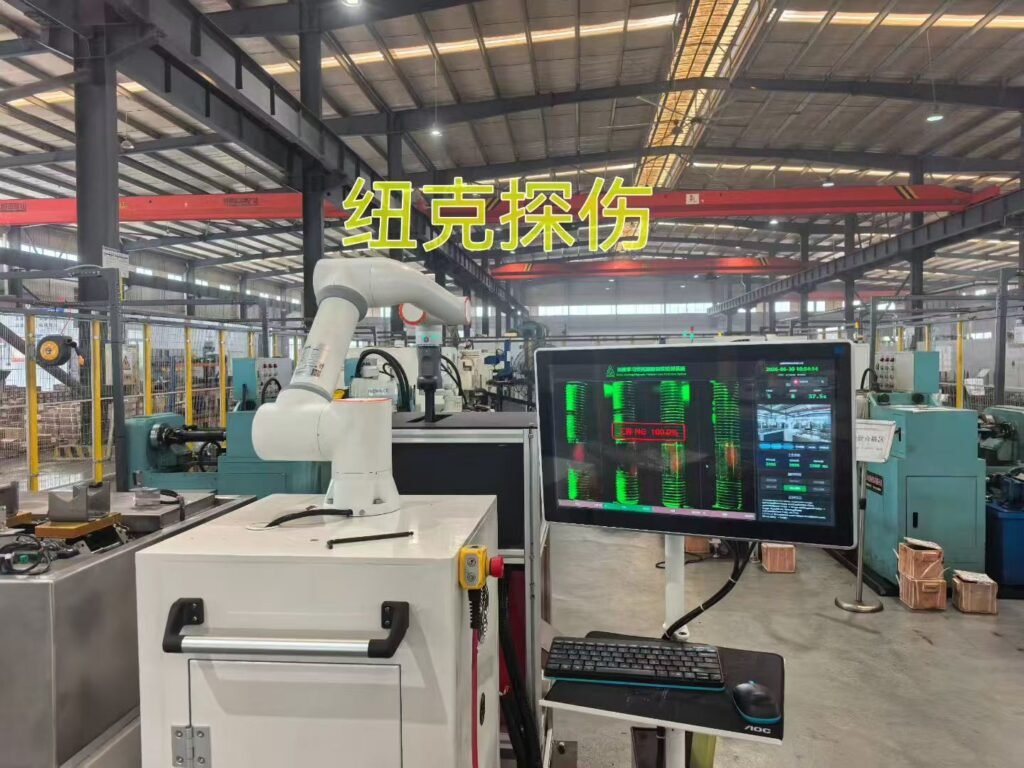
The AI vision system captures inspection images and analyzes the indications automatically, determining whether defects exist and providing inspection results in real time.
How Does AI Defect Recognition Work?
An AI-based MPI system typically includes the following steps:
1. Image Acquisition
High-resolution industrial cameras capture fluorescent magnetic particle patterns on the component surface under controlled lighting conditions.
2. AI Image Analysis
Deep learning algorithms analyze captured images and identify abnormal indications, including:
- Linear cracks
- Surface discontinuities
- Grinding cracks
- Fatigue defects
- Irregular magnetic particle accumulations
3. Automatic Inspection Judgment
The AI system compares detected indications with preset inspection criteria and provides automatic evaluation results.
4. Data Recording and Traceability
Inspection images, defect locations, and test results can be stored automatically for quality tracking and production analysis.
Advantages of AI-Based MPI Inspection
1. Improved Inspection Accuracy
Manual magnetic particle inspection relies heavily on operator experience and attention. AI recognition technology provides consistent inspection results and reduces the risk of missed defects.
2. Higher Production Efficiency
AI inspection enables automatic defect recognition without requiring inspectors to check every component manually, making it ideal for high-volume manufacturing environments.
3. Reduced Human Error
Factors such as fatigue, lighting conditions, and differences between operators may affect inspection results. AI technology provides stable and repeatable evaluation.
4. Intelligent Quality Management
AI inspection systems can connect with industrial databases and production management systems, creating complete inspection records for each component.
Applications of AI Magnetic Particle Inspection
AI-powered MPI technology can be applied to various industries:
Automotive Industry
- Control arms
- Steering components
- Engine parts
- Forged components
- Safety-critical parts
Aerospace Industry
- Aircraft landing gear components
- Engine parts
- Precision forged parts
Railway Industry
- Wheels
- Axles
- Bogie components
Heavy Equipment Industry
- Large castings
- Welded structures
- Machinery components
AI MPI vs Traditional Manual Inspection
| Feature | Traditional MPI | AI MPI |
|---|---|---|
| Inspection method | Manual visual evaluation | Automatic image recognition |
| Inspector dependence | High | Low |
| Inspection consistency | Depends on experience | Stable and repeatable |
| Data recording | Manual | Automatic |
| Production integration | Limited | Suitable for smart factories |
AI Magnetic Particle Inspection for Smart Manufacturing
As Industry 4.0 continues to develop, manufacturers are moving toward automated and digital quality control systems.
AI-powered MPI equipment supports:
- Automated inspection lines
- Real-time defect monitoring
- Digital inspection reports
- Production traceability
- Smart factory integration
This makes magnetic particle inspection not only a testing process but also an important part of intelligent manufacturing.
Conclusion
AI magnetic particle inspection represents the next generation of non-destructive testing technology. By combining magnetic particle testing, industrial vision systems, and artificial intelligence, manufacturers can achieve faster inspection, higher accuracy, and improved quality control.
For automotive, aerospace, and industrial component manufacturers, AI-based defect recognition provides a smarter solution to detect cracks and ensure product reliability.
Advanced AI MPI systems are helping manufacturers move from traditional inspection to intelligent automated quality control.